
Decades of Talking, Silos Still Winning
We’ve been talking about ‘breaking down silos’ for decades, yet teams still work in isolation, duplicating efforts and blurring accountability across leadership teams. Despite continued prioritization, cross-team alignment remains a challenge in nearly every organization.
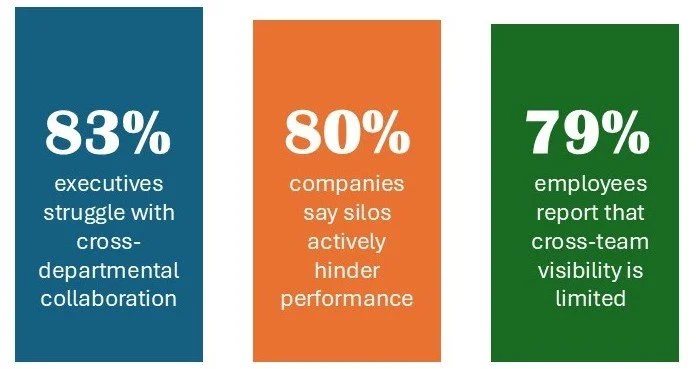
Why Silos Persist
Silos survive because incentives and accountability reinforce them.
Teams are measured and rewarded for what they deliver within their function. Collaboration is encouraged rhetorically but rarely built into how success is defined. When pressure mounts, teams default to what they are rewarded for.
More telling is the lack of ownership. Everyone agrees that silos are a problem, yet few organizations can name who is accountable for cross-team alignment. When collaboration belongs to everyone, it belongs to no one.
The Cost Organizations Underestimate
The biggest cost of silos is not friction. It is duplication.
Teams solve the same problems in parallel, repeat research, rebuild tools, and revisit decisions because context is lost between functions. These costs rarely appear on a balance sheet, but they quietly drain time, budget, and momentum.
Missed opportunities compound the damage. When insights fail to travel, strategy weakens and innovation stalls. Silos do not just slow execution. They dilute impact.
Why Common Fixes Fall Short
Most responses to silos focus on behavior. More meetings. More tools. More expectations to “collaborate better.”
But collaboration cannot rely on goodwill alone. Without shared outcomes, teams optimize locally. Without structure, conversations fragment. Without facilitation, priorities compete rather than align.
The result is activity without progress.
What Actually Works
Organizations that make progress do three things well.
They assign clear ownership for cross-team alignment. They define shared outcomes that span functions. And they use third-party facilitators to structure critical conversations and drive decisions.
The goal is not to eliminate silos. It is to intentionally design where and how teams align when it matters most.
Final Thought
Silos persist not because they are unsolvable, but because organizations tolerate their cost. Until collaboration is owned, designed, and measured, silos will continue to win.