
Why Patients Resist Change: How Defaults Shape Decisions
Many health decisions feel intentional, yet much of what people choose is shaped by defaults. A default is the pre-established choice presented to someone, which usually becomes their selection unless they actively choose something else. Richard Thaler and Cass Sunstein introduced this idea to a broad audience in their book Nudge, explaining that people tend to stick with defaults because they feel easier, feel endorsed, and avoid the effort of making a change. In healthcare, where information is complex and emotions can be high, defaults become especially influential.
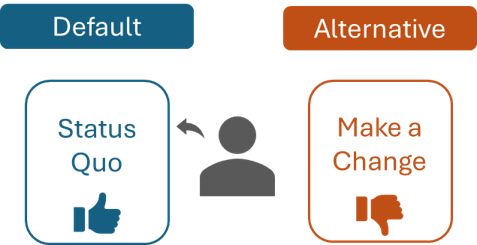
This influence appears in everyday health behaviors. Defaults affect whether patients enroll in reminders, refill medications, follow discharge instructions, or participate in screenings. When the healthier action is set as the default, engagement increases naturally. When a less helpful option is the default, follow-though declines even when patients are motivated to improve their health.
For care teams, this insight is practical and ethical. Reminder programs can be automatically enabled unless patients opt out. Patient portals can highlight the most important next step rather than an overwhelming list of choices. Refill systems can prepare renewals proactively instead of relying on patients to initiate the process. Thoughtful defaults reduce friction and support actions patients already intend to take.
For researchers, understanding defaults is essential. What patients say they prefer often differs from what they choose when confronted with real conditions. Research that tests different default settings reveals how people make decisions, where friction appears, and which options feel intuitive. These insights clarify the barriers that shape adherence, follow-through, and self-care.
In a world where health behaviors are easily disrupted, the default can matter as much as the message. When the simplest choice is also the healthiest one, patients are better supported in acting on their intentions.