
The Science Behind Customer Decisions
In a marketplace where consumers say one thing and do another, traditional research often struggles to uncover the real forces behind decision-making. Behavioral science changes that. By grounding research in how people actually think, feel, and behave, rather than how they believe they behave, brands gain a clearer understanding of the invisible drivers that shape choices, habits, and loyalty.
Tools like cognitive bias diagnostics, implicit testing, and choice architecture reveal why people bypass better options, abandon plans, or switch loyalties. Decisions are shaped less by stated attitudes and more by mental shortcuts, friction, emotions, social norms, memory, and perceived effort. These are the insights that make research far more accurate and actionable.
Behavioral science enhances research in three essential ways:
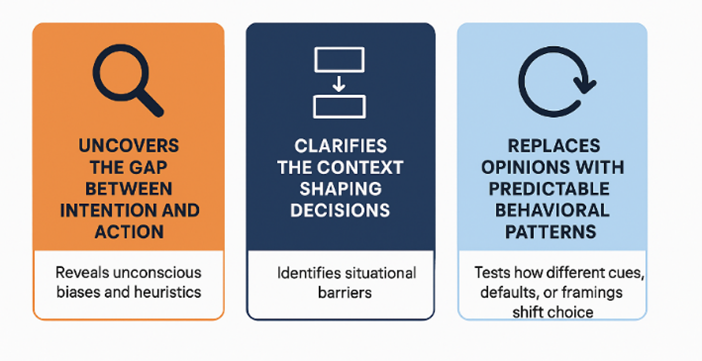
Uncovers the gap between intention and action. People often believe they will behave one way, yet real choices follow unconscious patterns. Tools such as implicit testing and decision journey mapping reveal these biases and provide a clearer view of what actually drives behavior.
Clarifies the context that influences decisions. A choice is never made in isolation. Environmental cues, moments of friction, and small disruptions can alter outcomes in ways consumers do not articulate. By examining the setting around a decision, researchers identify the hidden barriers that shape what people ultimately do.
Creates more reliable predictions. Behavioral frameworks allow researchers to test real decision cues rather than rely on opinions. This helps teams understand how different messages, defaults, or design elements will influence behavior in real conditions.
When behavioral science is integrated into research, insights become more accurate and more actionable. Messaging resonates more naturally, innovations solve real behavior challenges, and customer and patient experiences reflect the way people genuinely make choices.
Behavioral science does not replace traditional methods. It elevates them by connecting beliefs with actual behavior and providing a clearer path for brands that want to influence decisions with confidence.